
What a crushing plant quote actually needs
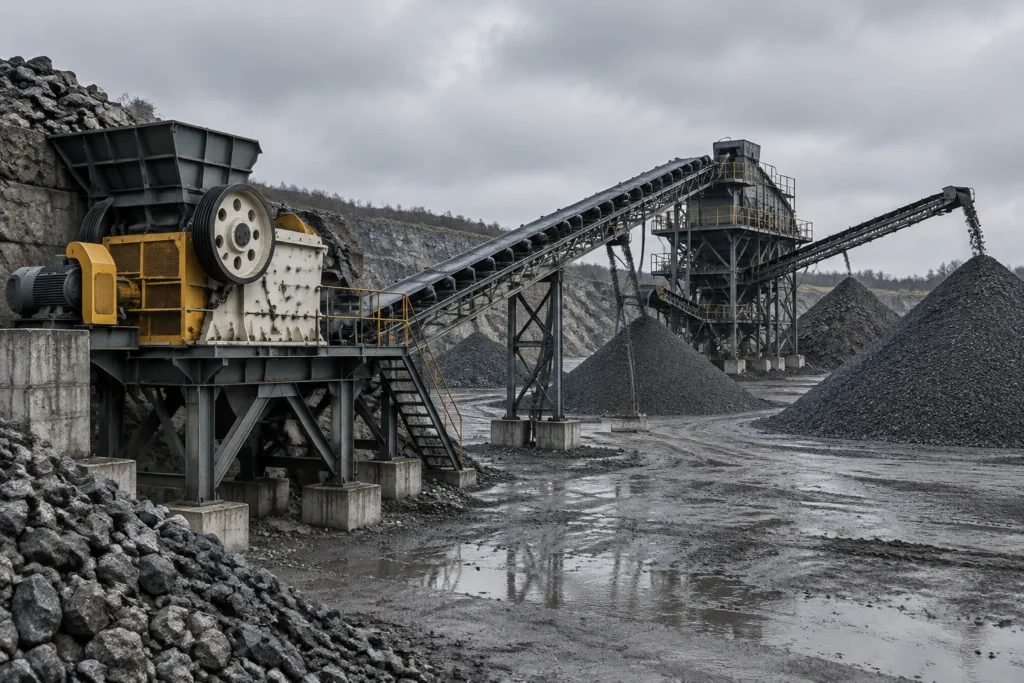
Most crushing quotes arrive as a number with no conditions attached, and that number is close to meaningless. A plant rated at 400 t/h on one rock is not a 400 t/h plant on another. Before any figure is worth comparing, five things have to be on the table.
1. The rock, as a sample
Not “granite” and not “hard”. A 200 kg sample, taken across the face rather than from one convenient pile, gives a particle-size distribution. UCS gives the strength. Abrasion index gives how fast the steel will disappear. Without these, the throughput is a guess dressed up as a specification.
2. The product, as cut points
“Aggregate” is not a product. 0/4, 4/20 and 20/40 mm are products, and each one sets a cut point, which sets a circulating load, which sets the size of the cone. A quote that does not name the cut points is quoting a different plant.
3. The setting
Open pit, decline or quarry bench. Underground, 4.2 m of clear height changes the frame design, the assembly sequence and the lead time. It is not a detail to be sorted out later.
4. The boundary
Who builds the foundations, who runs the cable, who supplies water. A quote without a scope boundary is a quote that will be argued about at month nine.
5. The date
First set and repeat steelwork are different numbers. Sixteen weeks for the first, ten for a repeat, because the second time the steelwork is already on a drawing number.
Send those five and a first mass balance comes back in fifteen working days. Send none of them and the honest answer is a range wide enough to be useless.
The service this note comes from

Open pit · Quarry · Underground
Circuit Design and Mass Balance
The balance sheet that fixes every number downstream, run from the mine's own sample before any steel is cut.
15 working days for the first balance