
Underground crushing: designing to 4.2 m of clear height
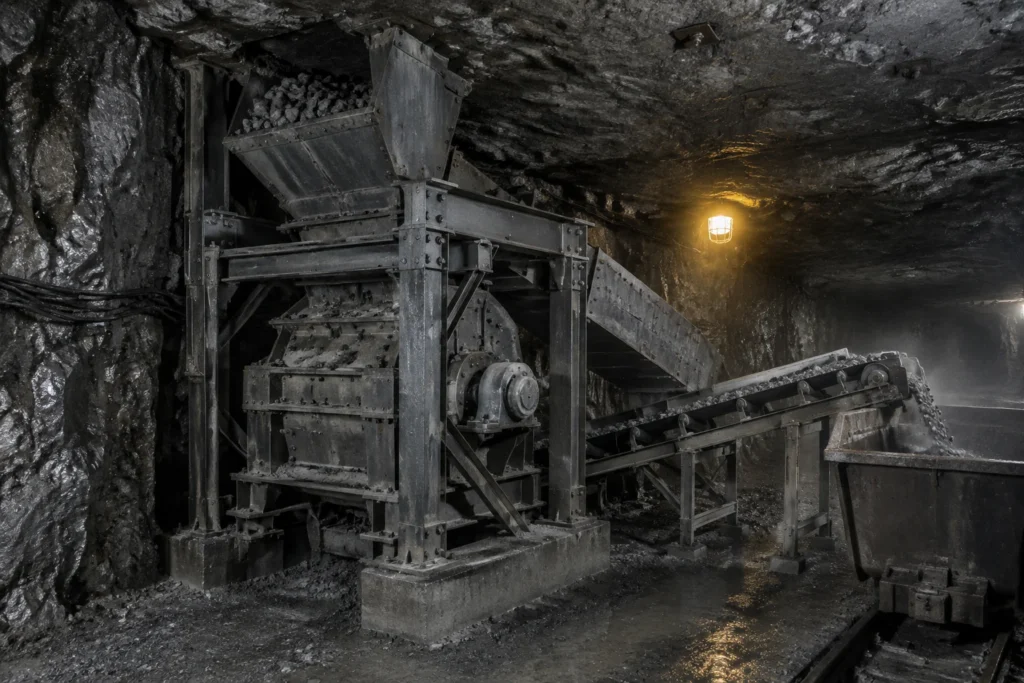
Underground crushing looks like a smaller version of a surface plant until you try to get the frame down the decline. Then it becomes a design problem in a different discipline: transport, assembly sequence and ventilation, in that order.
The cross-section is the specification
A transfer station inside 4.2 m of clear height is not a crusher with the legs cut off. The machine has to sit low enough to receive from the haul and discharge onto the skip, with the maintenance access still inside the envelope. That envelope is drawn before the machine is chosen.
Bolted, not cast
A cast frame that will not pass the decline is not a frame, it is a delivery. The RC-J1200 is a bolted fabrication so it ships in sections of roughly 2.1 × 1.9 × 3.4 m and is assembled at the station.
Write the sequence first
The assembly order is a drawing, issued with the steelwork. If the crew is deciding the order at the station, the first thing that happens is a lift that cannot be made.
Capacity is not the constraint
180 t/h underground against 400 t/h on the surface is not a weaker crusher. The limit is the skip and the airflow. Sizing the crusher larger than the skip just moves the queue.
The service this note comes from

Open pit · Quarry · Underground
Circuit Design and Mass Balance
The balance sheet that fixes every number downstream, run from the mine's own sample before any steel is cut.
15 working days for the first balance